



A watershed moment
Jensen Huang is out as CEO of Nvidia. Whatever you make of the scandal around his departure, one consequence is already clear: open-source AI just lost its most powerful friend.
Nathan Lambert (@natolambert), one of the sharpest observers of the open-model world, titled his response at Interconnects "Open-source AI without Jensen," with the subtitle "A decapitation. It's time to rebuild." He calls the resignation "a major setback for the US development of an open model ecosystem," and he's blunt about what Jensen did: "He was willing to use his power on open models."
On X, the mood is darker. Desiree Fixler (@desireefixler), quoting her own longer post about kill switches on “chips, data centers, and eventually AI,” put it in seven words: “This is a war on open-source AI.” A 48-second clip of Jensen, posted under the caption “This is why they want him gone,” has passed 1.5 million views.
The fear is easy to state. Open models had a champion at the company that makes the chips everything runs on. He pushed back when regulators and safety campaigners came for open weights. Now he's gone, and the people who think open models are dangerous have a clear field. Lambert names the worry directly: "sloppy regulation at the state level, followed by national regulation."
I take that seriously. I just don’t think it ends the way people fear.
Why the open source ban fears are overblown
We’ve been here before. Every time a powerful open technology has shown up, someone has tried to ban it, fence it or own it. Open has won those fights far more often than it’s lost.
Encryption. In the early 1990s, strong encryption was legally treated as a munition. Exporting it required a license. When Phil Zimmermann's PGP spread over the internet, he spent three years under federal criminal investigation, until prosecutors dropped the case in January 1996 without charging him. In 1993 the NSA introduced the Clipper chip, a phone encryption device with a built-in key escrow so the government could listen in. Civil liberties groups pushed back, researchers found holes in it, manufacturers passed on it, and by 1996 it was dead. Daniel Bernstein took the export rules to court, and federal judges agreed that encryption source code raised real First Amendment questions. In January 2000 the US greatly relaxed its export rules, open-source software included. Today strong encryption ships by default in every phone and browser on earth.
Linux. In 2001, Microsoft CEO Steve Ballmer called Linux “a cancer.” Microsoft then backed SCO’s legal campaign against it. In 2014, Satya Nadella stood on stage and said “Microsoft loves Linux.” Linux had become the operating system the cloud runs on.
The internet and the web. In 1996, Congress passed the Communications Decency Act to police online speech. The Supreme Court struck down its key provisions in Reno v. ACLU the next year. The open web kept growing.
None of those fights was won by a single protector. They were won because the technology was already everywhere and too useful to give up.
Open source AI models will win the same way. Closed models won’t go away. A mix of open and closed is inevitable, just as we have Windows and Linux, iOS and Android. The real question is what shape the open part takes.
The wrong target
Here’s where I part ways with much of the current conversation.
Lambert argues that “the only lasting solution to this is to incubate a truly frontier open model player in the US.” He leans on Dylan Patel of SemiAnalysis, who said on a ChinaTalk and SemiAnalysis podcast that building a better open model is “not that easy. It’s not money, it’s talent, man,” and that “if we don’t have a scale advantage, then you don’t win.”
I think Dylan is right about the game, and that's exactly why open source shouldn't play it. Matching the closed frontier on scale means competing on the closed labs' terms: their talent pools, their compute and their capital. Lambert himself writes that with compute "in such short supply," "the closed labs with better economies of scale and integration from model to datacenter and chips will win." If that's the contest, open source loses it by definition.
The idea that open source has to match closed source capability is the mistake. The goal should be efficient models aimed at specific capabilities, plus an architecture in which many small models fill niche roles inside a Human-Machine Intelligence ecosystem.
That’s the shape that is:
Doable. You don’t need a $40 billion round to build a great model for legal triage, soil analysis or a local language.
Impossible to ban. You can regulate five labs. You can’t regulate a hundred thousand small models running on people’s own machines.
Endlessly scalable. It grows by adding nodes, not by building bigger data centers.
Good for both kinds of intelligence. The human isn’t removed from the loop. People direct, combine, check and improve the models, and the network gets smarter as both sides do.
Lambert actually names the right lane himself. He writes that the open model economy “has correctly latched onto ‘ownership of intelligence’” as a crucial lane. I agree completely. Ownership of intelligence doesn’t point toward one giant American open lab. It points toward many owners.
The plumbing for that is arriving. This week llama.cpp, the engine under much of local AI, hit version 1.0 with a stable API. Its team says it supports more than 150 model architecture variants "across a wide range of hardware - from consumer-grade local machines to high-end enterprise servers," and that they expect growth "as local AI and privacy become increasingly important in our everyday lives." That's an ecosystem maturing from the bottom up, and it didn't need a CEO's blessing to do it.
A patron is a single point of failure
The line in Lambert’s piece that stuck with me most is this one: “The fundamental problem is that the open-weight ecosystem needs someone who will pick up the phone to abate a crisis.”
He goes on: “The most likely allies we could turn to are from the hyperscalers, the likes of Zuckerberg, Andy Jassy, or Satya.”
I understand the instinct. But look at what that sentence describes. If open AI's survival depends on one powerful person's willingness to use their power, it's a patronage, not a movement. Swap Jensen for Zuckerberg, Jassy or Satya and you haven't fixed anything. You've just moved the single point of failure. A patron's interests can change, their board can change, and as we just saw, they can be gone in a week.
There's a deeper choke point too: hardware and cloud. Open weights mean little if the chips and data centers that run them are controlled by a handful of companies, and Desiree Fixler's warning about kill switches on chips and data centers is really a warning about that. Even llama.cpp notes that it relies on "hardware support from NVIDIA, AMD, Qualcomm, Arm, IBM and Intel" for its test runners. Openness that lasts has to reach down to the devices people actually own, not just the model files.
Lambert ends by calling for “soul-searching and coalition building to construct a new platform.” Yes. But build the coalition as a network, not around a new patron. Networks don’t need someone to pick up the phone. They have thousands of phones.
The real danger
What worries me most isn’t a ban. It’s what fills the vacuum.
When one figure falls and the counterweight goes with him, the path opens for something much more concentrated: a public-private intelligence monolith, with a few frontier labs, a few hyperscalers and the government locked together, deciding what intelligence gets built, who can run it and on what terms. To be clear, that's a hypothesis, not a prediction. But the fact that the fall of one person could open that door at all shows how fragile the current arrangement is.
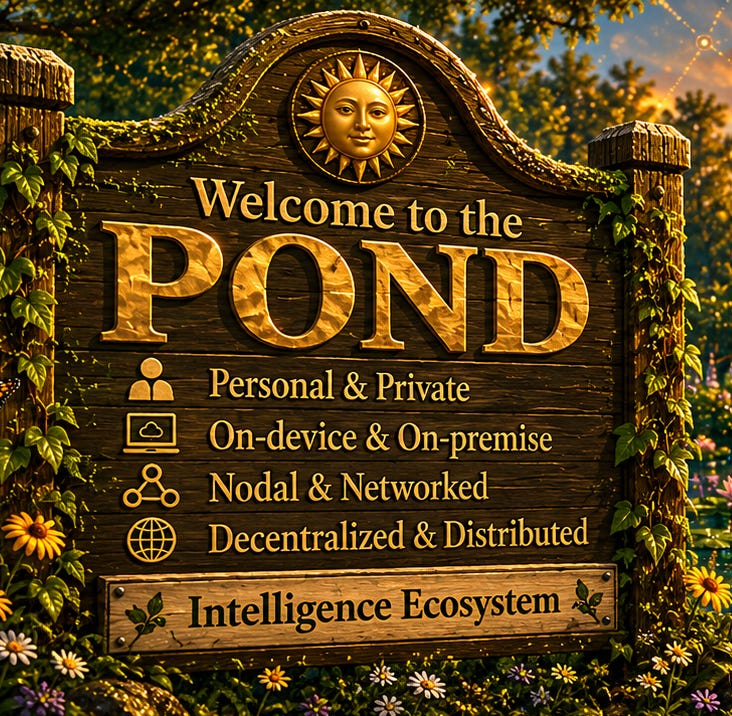
The POND Principle is the answer
The POND Principle answers vertical centralized power with horizontal, distributed, networked capacity.
Local intelligence isn't automatically secure—a model on your laptop can still be badly built, poisoned or misused, and distributed systems bring their own security headaches—but the argument for horizontal intelligence isn't that it's risk-free. It's that it spreads the risk, the capability and the control across many nodes, so no single failure, scandal or bill can switch it off. Small models are a regulation hedge, not because they escape responsibility, but because rules written for frontier-scale training don't map neatly onto a thousand niche models doing a thousand specific jobs in many constantly self-reconfiguring intelligence networks.
Vertical power has one throat to choke. Horizontal capacity doesn’t.
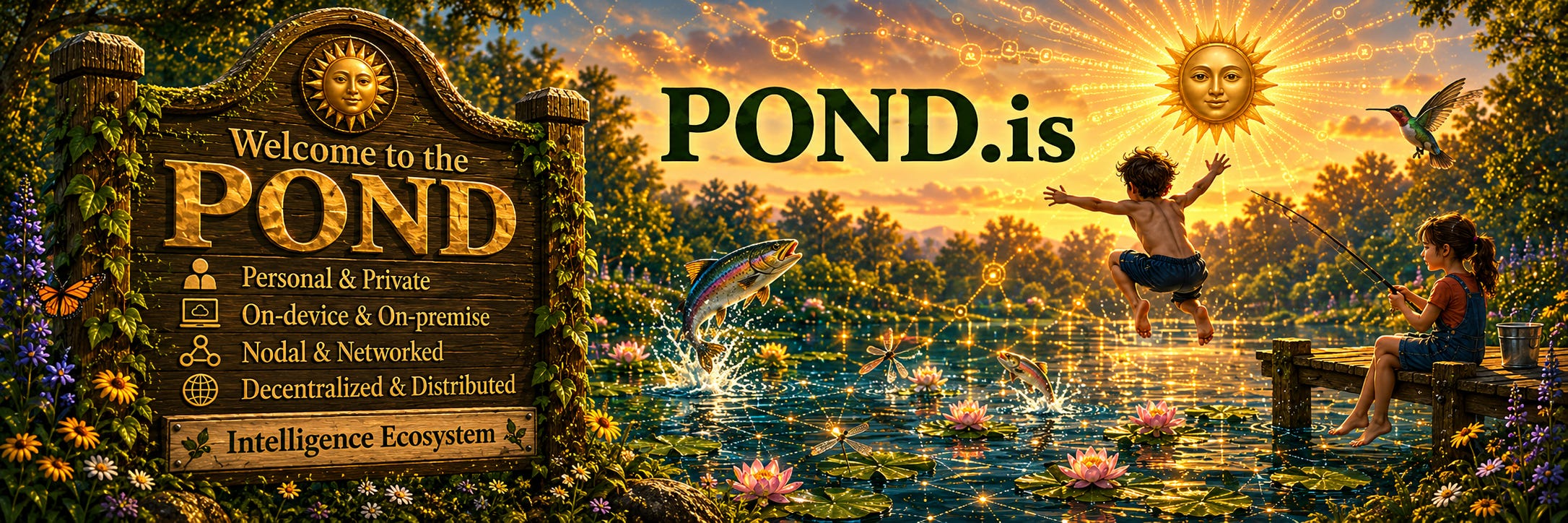
Gone fishin’
So let Jensen sit on the end of the POND pier, straw hat on, line in the water. The open-source ecosystem doesn’t need him back on the throne to survive, and it doesn’t need a replacement king. It needs a pond: lots of small, living, connected things, each doing its part, none of them in charge. And maybe Jensen will want to jump in and be the big fish that helps the ecosystem thrive.
That’s what we’re building towards with the POND Foundation, a horizontal Human-Machine Intelligence ecosystem where people and their models work together as a network rather than as customers of a monolith.
The POND Principle: For a Human-Machine Intelligence Ecosystem
Personal & Private
On-Device & On-Premise
Nodal & Networked
Distributed & Decentralized
And come discuss these ideas with us.
The PONDcast meets Tuesdays at 7:30 AM PT (4:30 PM Central Europe, 10:30 AM New York) in the POND Discord.
Bring your builds, your doubts and your best case for why I’m wrong. That’s how a network gets smarter.

Sources: Nathan Lambert, "Open-source AI without Jensen," Interconnects, Nov 14, 2026; Desiree Fixler (@desireefixler) on X, Nov 14–15, 2026; @_furnx on X, Nov 14, 2026; ggml-org, "llama.cpp v1.0.0: A stronger foundation for the local AI ecosystem," Hugging Face blog, Nov 13, 2026; Brookings, "A brief history of U.S. encryption policy"; Philip Zimmermann case-closed release, Jan 1996; Reno v. ACLU, 521 U.S. 844 (1997).