


A Bank Takes Back Its Intelligence
Revolut, the London-based digital bank with tens of millions of customers, is reportedly moving about 2,000 engineers onto self-hosted open models. The figure going around is roughly a tenth of its previous cloud AI bill, around $0.30 per million tokens on a cluster of 56 B200 GPUs.
Revolut hasn’t put out a formal announcement. The source appears to be a talk by David Abitbol, Revolut’s head of AI operations, at AI Engineer NYC on October 13. He described open models running on dedicated GPUs through a US-based provider. So this is self-hosted, not literally inside Revolut’s own data center. That distinction matters, and we’ll come back to it.
The cost savings are what’s getting the attention. But the more important point is who is making the move. Revolut is a regulated bank in the UK and EU. Its code, its internal reasoning and its customer context are some of the most sensitive data there is. When an organization like that decides to run its own intelligence instead of renting it from a handful of central providers, it’s not just about the bill. It’s about control. The work stays private. It stays out of someone else’s training data. It answers to the organization that depends on it.
Discovering POD
POND stands for Personal & Private, On-device & On-premise, Nodal & Networked, Decentralized & Distributed. It describes a future where Human-Machine Intelligence (HMI) belongs to the people and organizations who use it, not to a few companies that own the clouds.
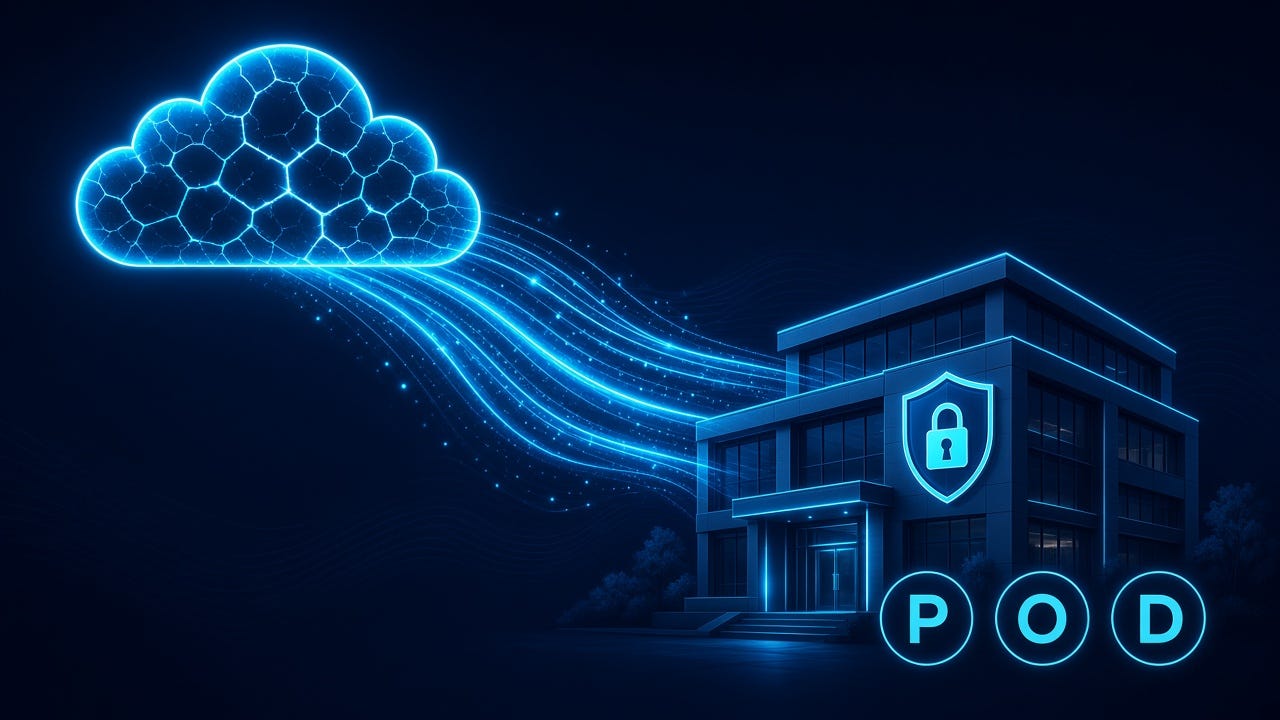
Looking at Revolut, a viable subset of POND came into focus: POD.
Private: the organization’s work and data stay its own.
On-premise: intelligence runs on infrastructure the organization controls. Self-hosting is a real step in that direction.
Decentralized: control shifts away from a few central AI providers and toward the many organizations running their own models.
Why decentralized and not distributed? Revolut isn’t spreading its intelligence across a network. It’s pulling control out of centralized machine intelligence and taking ownership of it. That’s decentralization. Distribution becomes the better word once nodes start connecting and intelligence actually flows between them.
What POD leaves out is the N: Nodal and Networked. In many cases today, the N isn’t necessary, isn’t appropriate, or simply isn’t built yet. A company can stop at POD and still capture most of what matters right now: privacy, control, cost and independence.
Self-Hosted Is a Step, Not a Detour
Some will say self-hosted on rented GPUs isn’t “really” on-premise. Fair enough, as far as it goes. But self-hosting is a meaningful move in the right direction. The model weights are open, the deployment is dedicated, and the organization decides how its intelligence runs. That’s a long way from sending every prompt to a general-purpose cloud API.
We’re taking the same path ourselves. Inti, the personal node technology from Intelligence Systems, plans to start self-hosted rather than on-device. Not because on-device isn’t the goal, but because that’s how real transitions happen. You move the control first. The hardware follows.
This is the honest shape of the shift. The distribution of intelligence to the edge will be a gradual trickle, not a sudden tectonic event. Cloud and local will coexist for a long time in a mixed ecology, each doing what it does best. The question isn’t cloud versus local. It’s who holds the keys, and in which direction the keys are moving.
Then Comes the N
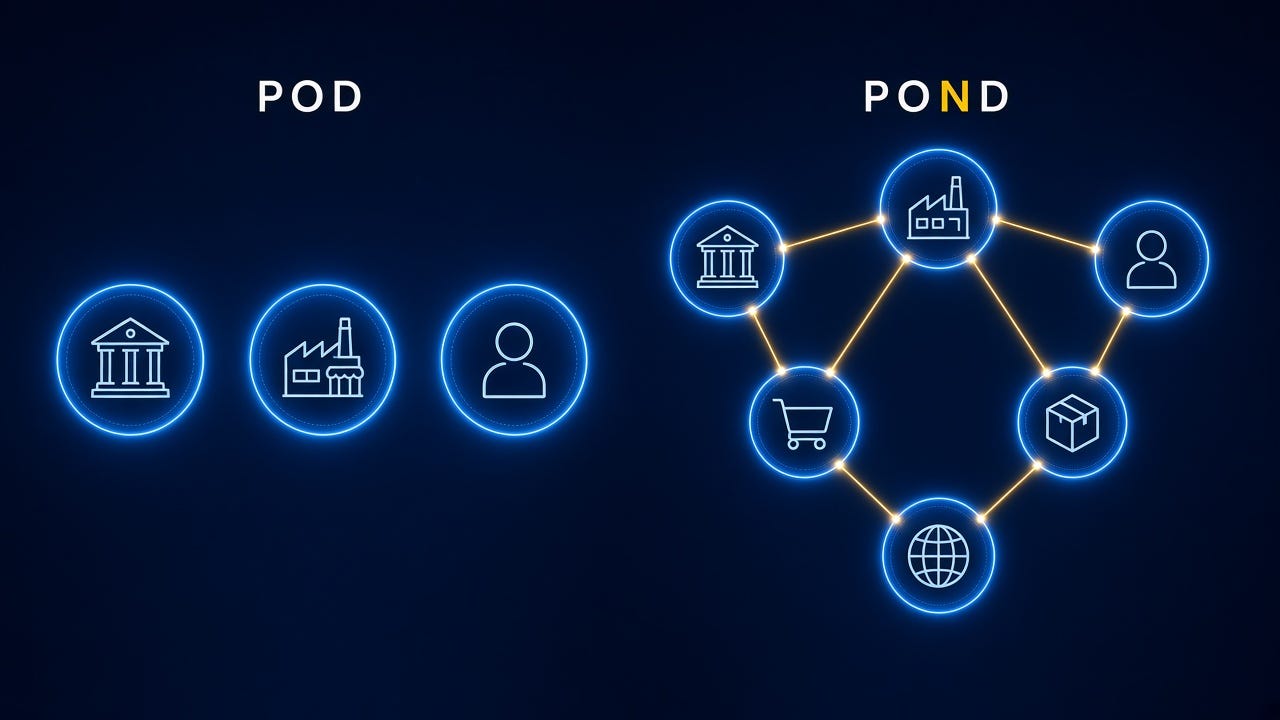
POD is where many organizations will start. POND is where they can go.
The N isn’t only about personal nodes. Companies and institutions can be nodes too, dynamically exchanging intelligence with partners, vendors and collaborators in shared development, without handing everything to a central intermediary. Imagine a bank’s node working securely with an auditor’s node, or a manufacturer’s models collaborating with a supplier’s, each private and each owned, with the value created in the connections between them.
Getting that right takes work: secure protocols, trust, permissions and clear boundaries on what gets shared. Until those details are worked out, stopping at POD is a reasonable choice. But once the N is in place, intelligence stops being a set of silos and becomes an ecosystem, one that includes individuals, not just enterprises.
Enterprises are proving POD today. Personal nodes come next. Then the network ties them together.
Join Us
POND is building toward a Human-Machine Intelligence that’s private, owned and networked by design. If that future matters to you, come help shape it.
Learn more at pond.is
Join the conversation on Discord: https://discord.gg/kNvtcjPmJ7
Tune in to the PONDcast, Thursdays
POD first. Then POND.