


A clip of Anthropic CEO Dario Amodei has been making the rounds this week, and it deserves more attention than a typical pricing remark.
As summarized by the account that posted it, Amodei’s point is that not all tokens are equal. Some of what Claude produces is worth a few cents, while some could be worth tens of millions of dollars. His examples make the contrast clear. Telling someone to restart their Mac is advice the model has given millions of times, worth a dollar or less. Telling a pharmaceutical company to move an aromatic ring to the other end of a molecule could be worth tens of millions. From there, he suggests we should expect experiments with pay-for-results pricing, or labor-like pricing by the hour, because this is a new industry and many models will be tried.
The same post notes that pricing today is simpler: according to Anthropic’s S-1, usage-based pricing made up 80% of first-half 2026 revenue and subscriptions the other 20%.
Victor Shammas responded with an analogy that stuck with me: imagine a power company charging more for electricity because you used it for particularly valuable work. He called outcome-based pricing “pure techno-rentierism.”
I think he’s right, and I think the clip is worth taking seriously. Amodei isn’t wrong about the economics. He is describing, honestly, where closed AI economics lead.
A tool, or a partner who takes a cut?
There are two ways to pay for something that helps you work.
You can pay for the tool. A hammer, a spreadsheet, electricity, a compute hour. The price reflects what it costs to make and run the tool, plus a margin. What you build with it is yours. If you build a house, the hammer company doesn’t own a room.
Or you can pay a partner who takes a share of the outcome. A royalty, a commission, equity. That arrangement can make sense when the partner brings something unique and shares the risk. But it changes the relationship. The partner now has a claim on your upside, and every incentive to increase it.
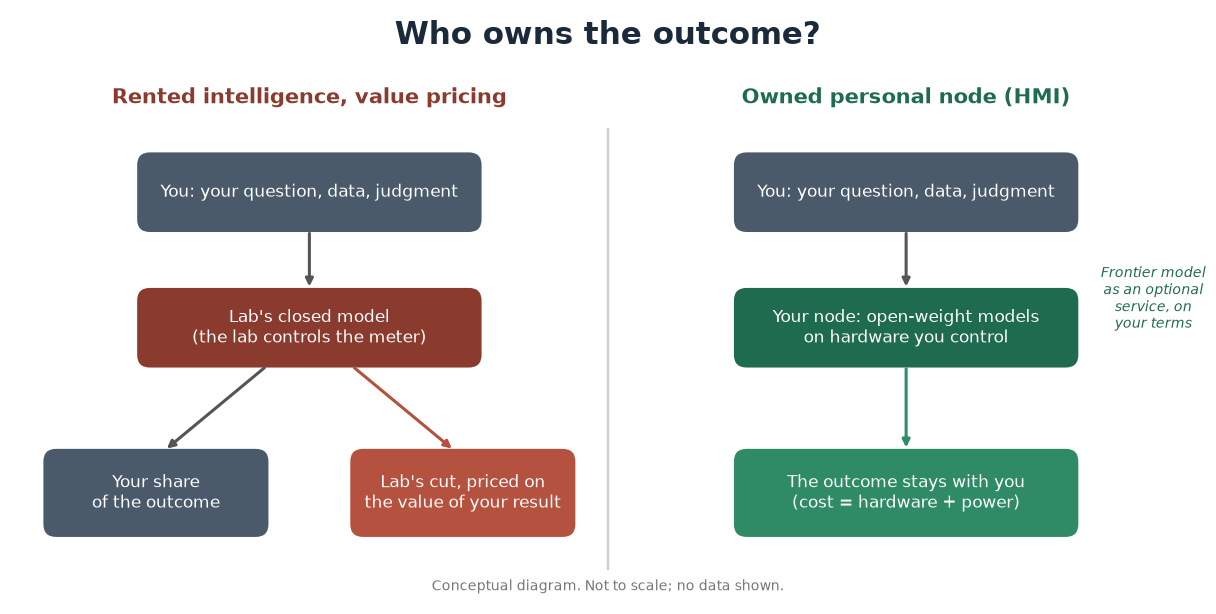
Value-based pricing moves AI from the first category toward the second. If the price of intelligence is set by the value of your result, then the more creative, valuable and original your work is, the more of it goes to the lab. The aromatic ring is the chemist’s insight as much as the model’s. The question the model answered was framed by a human, inside a human’s company, using that company’s data and years of experience. Under outcome pricing, the lab still gets paid as if the breakthrough were its own.
That’s the part I want to name clearly. It isn’t a cut of the model’s work. It’s a cut of your work.
Why closed labs end up here
None of this requires bad intentions. It follows from the structure.
Frontier labs spend enormous sums on training and data centers. Per-token prices keep falling as competition grows and open-weight models close the gap, which I wrote about in The Gap Closed. When the commodity price of intelligence drops, a closed lab has two options. It can compete on cost, or it can find a way to price on value instead of cost. Value pricing is the natural move for anyone who controls a scarce input and wants to keep margins as the input stops being scarce.
This is what I mean by Intellinomics: the economics of intelligence itself. Intellinomics asks who produces intelligence, who owns it and who captures the value it creates. When intelligence is rented, the landlord sets the terms. Today the terms are per token. Tomorrow, by the CEO’s own description, they may be per outcome.
The same logic shows up in other places. In Seven Billion Intelligences I argued that an agent which answers to someone else’s incentives will, sooner or later, act on those incentives. Pricing is just the most direct version of that. If your intelligence is metered by someone who profits from the size of your success, then your success is partly theirs by contract.
As I put it in The Gap Closed, “A price cut makes renting cheaper. It doesn’t make it ownership.” Value pricing is the reverse case. It makes renting more expensive exactly when you do your best work.
The alternative is already running on small devices
Here is what makes this moment different from a few years ago: owning your intelligence is no longer a sacrifice.
On October 27, Liquid AI released LFM3, six open-weight 2B-class models covering text, vision, audio, omni and decision tasks, all built on one shared backbone. The text model, LFM3-1.7B, fits in about 1 GB at 4-bit precision and has a 256K-token context window. Liquid says it is post-trained to run in agent harnesses and can handle things like inbox triage, calendars and web research. The family has native support for llama.cpp and MLX from day one, and Liquid says every model can be fine-tuned on a single GPU.
Liquid’s own benchmarks show the small text model competing with models several times its size on agentic and tool-use tasks. They’re also candid that larger models still win on knowledge and agentic coding, where size matters most. That honesty is useful. Nobody needs to claim a 2B model beats the frontier at everything. The point is that a model small enough to live on your laptop or phone is now good enough for a large share of daily work.
One line in Liquid’s announcement says it plainly: “Since tokens are free, dozens of agents can run continuously in the background.” On your own device, the marginal token costs you electricity. And no electricity company charges you more because the work was valuable.
Human-Machine Intelligence keeps the surplus with the human
This is the core of POND and of Human-Machine Intelligence.
HMI isn’t a person using a service. It’s a person and their own machine intelligence working as one system: your context, your data, your judgment, and models that run on hardware you control. In that system, the question “who owns the outcome?” has a simple answer. You do.
A personal node changes the economics in three ways.
The cost is the tool, not the result. You pay for hardware, power and open models, most of them free to download. The price doesn’t rise because your idea was a good one.
Your context stays yours. The data that makes a model useful to you, such as your notes, your projects and your history, doesn’t leave to train someone else’s product or to set someone else’s prices.
You can still reach for the oracle. Owning a node doesn’t mean refusing frontier models. For the rare problem that truly needs one, you can call one. But you call it as a customer buying a service, on your terms, with your node deciding what to share. The frontier becomes a utility you visit, not a landlord you live with.
That’s the direction technologies like Inti by Intelligence Systems, a POND personal node technology, are built around: intelligence that lives with the person, learns their context and works on their behalf, not on behalf of a pricing model.
Who should own the aromatic ring?
Go back to Amodei’s example, because it’s a good one.
A chemist at a pharmaceutical company asks a question. The model suggests moving an aromatic ring. The suggestion turns out to be worth tens of millions. Who created that value?
The model contributed. So did the chemist who knew what to ask, the team who built the molecule, the company that ran the trials and the decades of human science the model was trained on. Outcome pricing hands the AI vendor a share of all of it, because the vendor controls the meter.
In a POND world, that same chemist runs capable models on infrastructure the company owns, fine-tuned on its own data. The insight is still a Human-Machine Intelligence result, but the surplus stays where the work and the risk are. The same holds for a solo developer, a teacher, a writer or a small business. The value of their best work shouldn’t come with a royalty attached.
A scenario: the hundred-chemist organization
Now picture the positive version of who owns the outcome. What follows is a vision, not a product that exists today, but it’s where Inti and Intellinomics point.
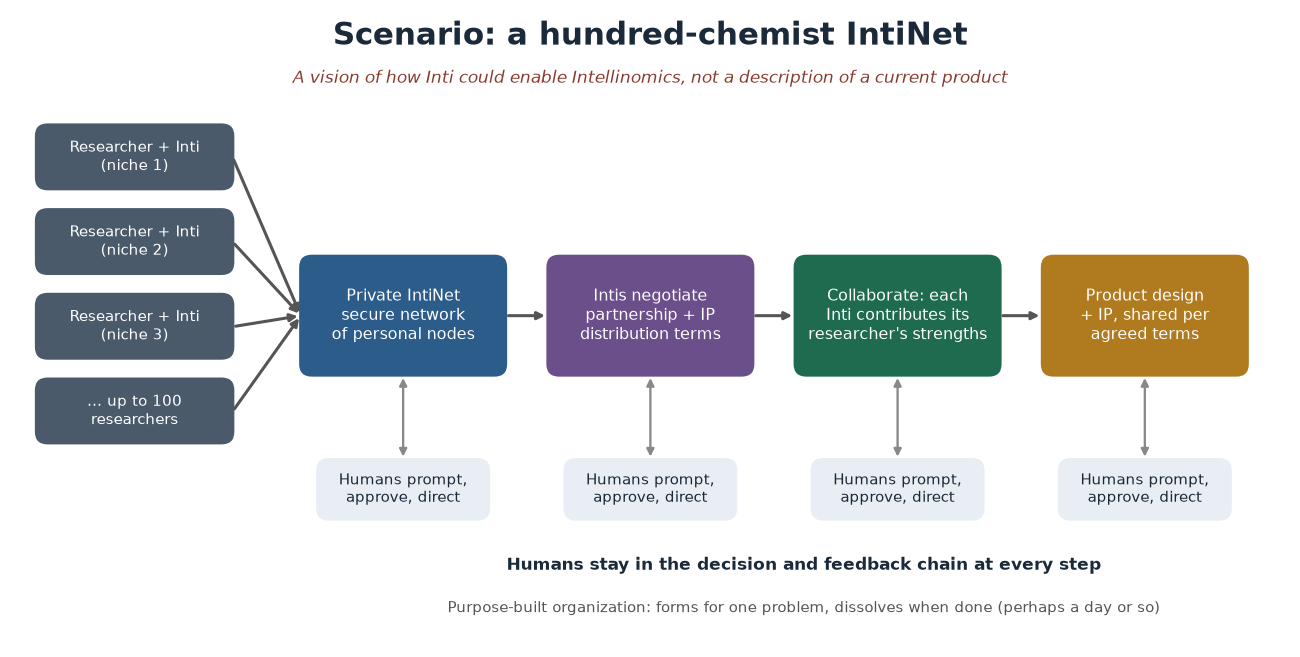
Imagine 100 biochemists around the world, each specializing in a narrow niche. One knows a particular enzyme family. Another knows a class of binding assays. A third has spent fifteen years on one metabolic pathway. A problem comes up that none of them could solve alone, but together they could.
They come together in a private IntiNet, a secure network of their personal nodes. Before any science happens, their Intis negotiate on their behalf. They draft a partnership agreement and the terms of IP distribution, with each researcher’s share reflecting what they bring. Each human reviews and approves the terms. No one signs anything they haven’t seen.
Then the work begins. Each Inti contributes according to the strengths of its researcher, drawing on that person’s knowledge, data and judgment, and sharing only what the agreement allows. The Intis coordinate, test ideas against each other and assemble the pieces. The humans stay in the decision and feedback chain the whole way, prompting, approving, redirecting and catching what the machines miss. This is Human-Machine Intelligence at the scale of a team: a hundred people and their machine intelligences working as one system.
At the end, perhaps in a day or so, they return a product design and the IP to go with it, already divided by terms everyone agreed to.
Think about what disappears in that picture. Months of contract negotiation. Most of the legal overhead. The friction of coordinating across institutions and time zones. The platform taking a cut of the outcome. What remains is massive value, created securely, owned by the people who created it.
And when the problem is solved, the organization can dissolve. Purpose-built organizations that last as long as they are needed, then return everyone to their own work, with the outcome in their hands.
That’s what I mean when I say Intellinomics changes who captures the value of intelligence. In the rented model, the meter belongs to the lab. In this model, the outcome belongs to the humans.
The choice in front of us
Amodei said this is a new industry and many pricing models will be tried. I agree. That’s exactly why the choice matters now, before habits and contracts harden.
One path makes intelligence a rented partner that takes a cut of what humans create. The other makes intelligence a tool people own, with the frontier available as a service when it’s truly needed. Small open models like LFM3 show the second path no longer asks people to settle for less.
The question isn’t whether AI will create enormous value. It will. The question is who owns the outcome. POND’s answer is the human.
Join us at POND, and bring your questions to the next PONDcast.
Steven Vincent